
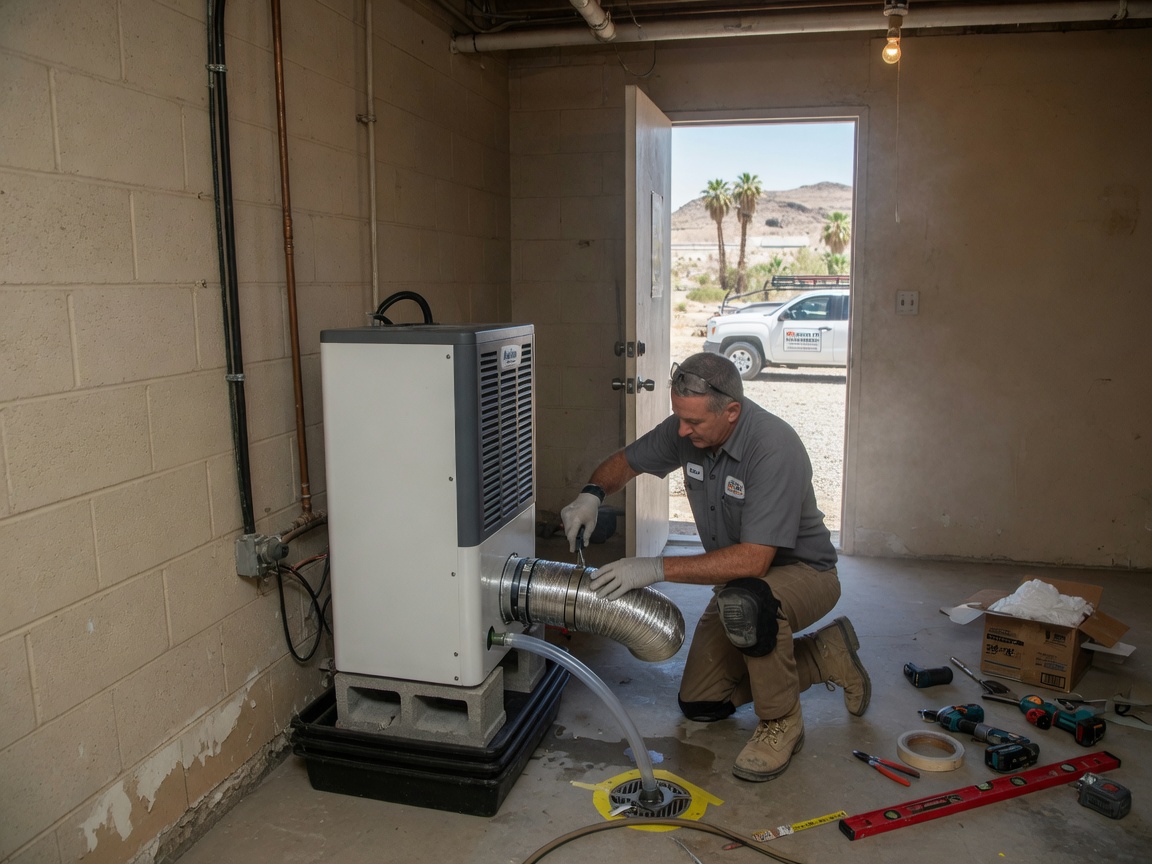
Boulder City’s hot desert climate forces air conditioners to run long hours in summer, often pulling moisture from the air that then condenses in ductwork or crawl spaces. In neighborhoods like Downtown Boulder City and Lakeview, many homes built before widespread central AC have undersized or poorly sealed return ducts that trap humidity. Installing a dehumidifier requires matching the unit’s capacity to the home’s actual latent load rather than square footage alone, and placing the drain line so it clears the alkaline soil common around the Boulder City Municipal Golf Course without clogging.
We run the dehumidifier’s intake and discharge through the existing HVAC system or dedicated ductwork so it does not short-cycle the main AC. In Clark County, building code requires a separate condensate drain with a trap and cleanout, and we always verify the unit’s defrost cycle works during the mild winter nights when temperatures drop enough for coil icing. Homes near Lake Mead sometimes see higher spring humidity spikes from reservoir evaporation, so we set the control to maintain 48-52 percent relative humidity rather than the default 55 percent used in drier inland spots.
Edge cases include tight crawl spaces under older Lakeview homes where we must use low-profile units and route condensate to an exterior French drain to avoid pooling against foundations. We also check that the dehumidifier’s power draw does not overload the 20-amp circuits common in 1960s-1970s Boulder City construction.
Technician insight
In Boulder City, the thing that catches most people out with Dehumidifier Installation is the alkaline soil eating through standard PVC drains within a couple of seasons if the line isn’t run with a proper cleanout and slight pitch toward the street side of Lakeview lots.
Lakeview Crawl Space Humidity
A 1970s Lakeview home showed 68 percent humidity in the crawl space even with the AC running. We found the original flex duct leaking cold air against the soil. We installed a sealed crawl-space unit, tied the drain to an exterior cleanout, and set the control to 50 percent. Humidity stabilized and the homeowner stopped seeing condensation on the supply ducts.
Dehumidifier Installation Services We Offer
✓Whole Home Dehumidifier Installation
Integrates a dedicated dehumidifier into the existing HVAC duct system to maintain steady humidity levels across the entire house during peak summer AC runtime.
✓Crawl Space Dehumidifier Installation
Places a compact, sealed unit in the crawl space to pull moisture from soil evaporation common in Lakeview and Downtown Boulder City homes.
✓Basement Dehumidifier Installation
Installs a high-capacity unit with gravity or pumped drain for homes that have below-grade spaces affected by seasonal reservoir humidity near Hoover Dam.
✓AC-Integrated Dehumidifier Retrofit
Adds a dehumidifier coil or standalone unit downstream of the existing air conditioner to handle excess moisture without replacing the full system.
✓Portable to Whole-Home Conversion
Removes multiple room units and installs a single central dehumidifier with proper ducting for consistent control in Clark County residences.
Dehumidifier Installation Cost in Boulder City, NV
| Service | Typical Range | What Affects It |
|---|---|---|
| Whole-home dehumidifier with duct tie-in | $1,200–$2,400 | Higher when adding new return and supply runs in older Downtown Boulder City homes. |
| Crawl space unit with exterior drain | $900–$1,600 | Depends on distance to suitable discharge point and soil conditions. |
| AC-integrated retrofit | $800–$1,500 | Lower when existing plenum access is clear; higher if coil relocation is needed. |
| Electrical circuit upgrade | $250–$450 | Required on 1960s-1970s homes with 20-amp limits. |
Ranges are typical for Boulder City, NV and confirmed with an exact written quote before any work starts.
How it works
- 1
Site Assessment
Measure humidity levels, inspect ductwork, and evaluate crawl space or basement conditions in the specific Boulder City neighborhood.
- 2
Unit Sizing And Placement
Calculate latent load based on local summer conditions and select a unit rated for the home’s construction era and orientation.
- 3
Duct And Drain Work
Run dedicated or tied-in ducting and install a code-compliant condensate line with cleanout accessible from outside.
- 4
Testing And Commissioning
Run the system through a full cycle, verify humidity targets, and confirm no condensate backs up during mild winter temperatures.
Pricing
Pricing varies by home size, existing duct access, and whether a new drain line must be run through slab or crawl space.